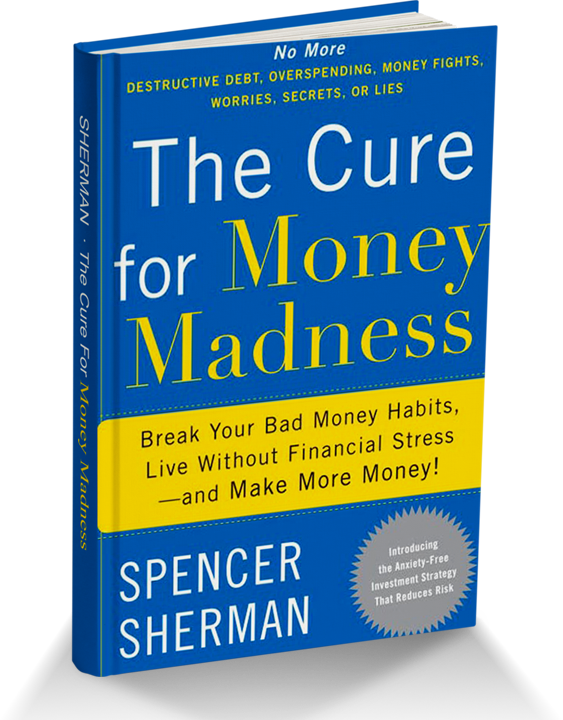






Another Spencer Sherman

Posted on January 30th, 2008 in Experiences | Leave A Comment

I recently had a meeting with an unrelated man named Spencer Sherman. He’s 16 years older than me, but we were both born and raised in the same New York City borough, and both moved to California later in life. We share similar values and interests, not to mention a name-very uncommon.

Yes, I was curious about another human being with the same name, but the bigger reason for our meeting was to offer him money for his website and its domain: www.SpencerSherman.com.  I brought up my interest and joked that my business partner was afraid I’d pay him $1 million for the site, and Spencer Sherman stopped, thought and said, “I might consider a million dollars, but just for a moment. Money doesn’t mean much to me and I’m enjoying my website.”

How unusual to find someone who doesn’t equate self-worth with net worth, who isn’t willing to sell his joy for money and who isn’t obedient to the call of money as a well-trained dog to its master.

I recall so many instances when I sold enjoyable, precious private time just to make an extra buck. I believed then that, as long as the price was right, you were supposed to sell your joy for money. I let my money madness override the true value of happiness.

I’ve gotten much better at keeping my money monster from running the show, but it’s still a practice.  With practice, each of us can dissolve the money madness and see the value of life beyond money.  The other Spencer Sherman’s peaceful connection to his own happiness over riches inspired a deeper inquiry into my own money madness, and how I can continue to transcend it. Indeed, sometimes we can see in others exactly what we want to cultivate in ourselves.

Money and Peace

Posted on January 28th, 2008 in Community, Uncategorized | Leave A Comment

Many of us operate on the principle that money is somehow antithetical to peace. We talk about having jobs that are well-paying or ethical, companies that are “corporate” and therefore bad. We seek guidance from spiritual leaders who took vows of poverty and religious verses condemning the lust for money. We focus on finding tranquility by releasing our attachment to the material world, in which money plays a starring role.

But what if the truth—money vs. peace, profit vs. ethics—just isn’t that black and white?

Consider MoveOn.org. With 3.3 million members, MoveOn.org has used Internet-based, grassroots community organizing to raise many millions of dollars. Those funds have paid for things like Viacom billboards reading “Inspections Work. War Won’t.” in major cities across the country, thousands of phone calls to Congress in advance of votes on torture and the war in Iraq, and DC rallies with tens of thousands of attendees exhorting the government to take action against genocide in Darfur.

From Patagonia to the Peace Corps to The Desmond Tutu Peace Foundation, there are thousands of organizations creating and supporting peace using not just volunteers and vision, but money. Cold, hard cash. Lean, mean green. (By the way—just look at the words we use to talk about money: cold, hard, and mean!)

The fact of the matter is that money is powerful, but it’s neither good nor bad—it’s neutral. As neutral as a spoon, a wheelbarrow, a paperclip. It’s simply a tool, and like all tools, it can be used for good or ill. A hammer can crash down on your finger or build a house. Fire can burn down your garden or cook your meals. Money can generate suffering, or it can generate peace and progress; and rejecting money because it can cause suffering is like refusing a hammer while building your house because you might accidentally hit your finger.

Rather than struggle to reject money because it’s bad, embrace money as a neutral tool, only as constructive or destructive as our intentions. The nature and scope of its power directly depend on how we use it.

In our progressive communities, many of us have a negative knee-jerk reaction to money. That reaction keeps us from seeing that money creates opportunities to improve the world. When we don’t see the benevolent, constructive side of money, we reject it, and those opportunities are lost.

Get clear on the neutrality of money, and you’ll create possibilities. Possibilities lead to opportunities. Opportunities lead to change. And in the hands of the progressive community, change leads to peace.

My RV Vacation

Posted on January 15th, 2008 in Experiences, Family, Money Madness | Leave A Comment

After fantasizing about an RV vacation for years, we decided to test drive the idea by renting one for a weekend getaway to a Northern California music festival.   We loved the music, and it was a wonderful weekend, but we discovered that we are not, as it turns out, RV people.  We much prefer camping, where we can cook and eat outside, our young children can run around the campground, and we aren’t separated from other families by four metal walls.

At the end of the weekend, we returned the RV to the rental place, and discovered that our Honda had been broken into.  The RV rental company had assured us the car would be fine, and against better judgment, we left it parked on the street; now, the passenger window was smashed to pieces, and our iPod and $20 in cash were missing. The total cost to fix the car, clean up the glass and replace the iPod was $700.  Add that to the $750 RV rental fee, and the test drive put us back $1,450. Ouch!

Had this happened 10 years ago, I probably would have been upset for a week, tried to make up the $1,450 by day-trading, and blamed my wife for the whole thing.

…I might also have bought an RV–not rented one–in order to determine how much we liked it.

But curing my money madness means that I make better, more sound financial decisions, and instead of seeing the weekend as a wasteful debacle, I see it as costly, but essentially worth the wisdom gained.

After all, I learned that my family just isn’t an RV family–and much better to make that discovery over the course of a weekend rental than a 6-year financing plan.

Losing money created the opportunity for me to practice gratitude, and to let go of the irrational desire to make up the loss.

That opportunity, in turn, was a chance for me to practice affirming that my self-worth is not bound to my net worth.  That alone is priceless.