




<?xml version="1.0" encoding="UTF-8"?>
<?xml-stylesheet href="http://feeds.feedburner.com/~d/styles/rss2full.xsl" type="text/xsl" media="screen"?><?xml-stylesheet href="http://feeds.feedburner.com/~d/styles/itemcontent.css" type="text/css" media="screen"?><rss xmlns:content="http://purl.org/rss/1.0/modules/content/" xmlns:wfw="http://wellformedweb.org/CommentAPI/" xmlns:dc="http://purl.org/dc/elements/1.1/" xmlns:atom="http://www.w3.org/2005/Atom" xmlns:feedburner="http://rssnamespace.org/feedburner/ext/1.0" version="2.0">

<channel>
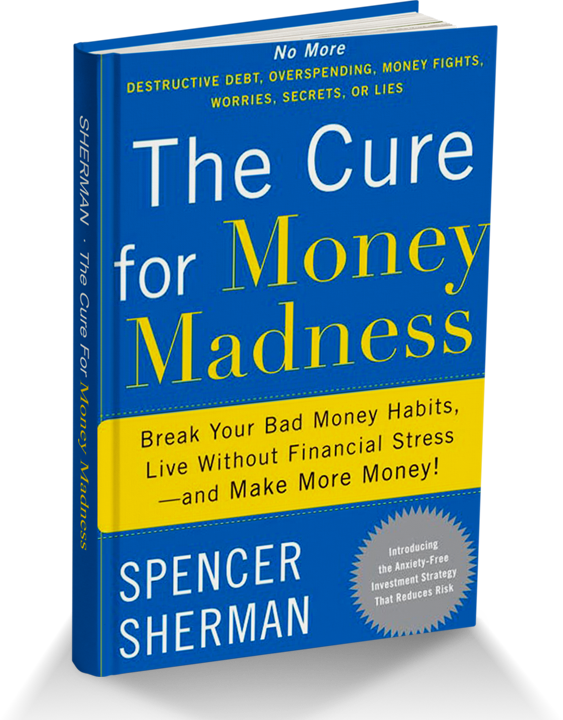
	<title>Spencer Sherman, The Cure For Money Madness</title>
	
	<link>http://www.curemoneymadness.com/blog</link>
	<description>Spencer Sherman, Author of The Cure For Money Madness</description>
	<pubDate>Mon, 05 Jan 2009 21:24:04 +0000</pubDate>
	<generator>http://wordpress.org/?v=2.6.2</generator>
	<language>en</language>
			<atom10:link xmlns:atom10="http://www.w3.org/2005/Atom" rel="self" href="http://feeds.feedburner.com/curemoneymadness/aLlo" type="application/rss+xml" /><item>
		<title>To Own or Not to Own</title>
		<link>http://feeds.feedburner.com/~r/curemoneymadness/aLlo/~3/503644229/</link>
		<comments>http://www.curemoneymadness.com/blog/2009/01/to-own-or-not-to-own/#comments</comments>
		<pubDate>Mon, 05 Jan 2009 19:22:08 +0000</pubDate>
		<dc:creator>admin</dc:creator>
		
		<category><![CDATA[Family Groove]]></category>

		<category><![CDATA[Real Estate]]></category>

		<category><![CDATA[Financial Crisis]]></category>

		<category><![CDATA[Housing Market]]></category>

		<category><![CDATA[Renting Vs. Owning]]></category>

		<category><![CDATA[subprime]]></category>

		<guid isPermaLink="false">http://www.curemoneymadness.com/blog/?p=165</guid>
		<description />
			<content:encoded><![CDATA[<p><strong></strong>Until the financial crisis that started last fall, no one  questioned the  value and importance of owning a home.    But when so many people   defaulted on their mortgages, people began    to see that renting is a<br />
viable and,     in some cases, preferable option.</p>
<p>Many of us grew up with the adage: “Renting is just throwing money down the drain.” Well, the subprime crisis has ended that delusion, and besides, it’s never been true that everyone should own a home even if they can afford one.</p>
<p><strong>In boom times or in  bust times, who shouldn’t own a home?</strong></p>
<p><strong></strong>Anyone who doesn’t have a firm intention to live in the  house for at least seven years.</p>
<p>Anyone who needs flexibility. For example, if you don’t want to limit your income potential, or want to keep your income options flexible, owning a house keeps you in one area, but the more lucrative jobs may be elsewhere.</p>
<p>Anyone whose marriage isn’t stable. Self-explanatory!</p>
<p>Anyone whose life is changing. For example, if you’re about to have your first child or about to be an empty nester, your world will change dramatically. Keep your options open while you’re in transition.</p>
<p>Anyone who’s arriving in a new neighborhood, job or a city should rent first before buying. In six months, you may be pining for the neighborhood your friends live in, but if you’ve bought, it’s too late. If your boss is a tyrant, renting allows you to relocate and start over—quickly.</p>
<p>Anyone who is disciplined enough to save money on his/her own should not buy. Most people need the forced savings of home ownership. But if you don’t, save on your own and keep your investments diversified in a mutual fund portfolio.</p>
<p>Anyone who must put all of their assets into a house. Putting all your eggs into one basket is never a good idea. Diversifying your assets is essential to keeping your portfolio healthy and balanced.</p>
<p>Anyone who doesn’t want the stress of home maintenance or doesn’t have the cash reserves for unexpected home repair/maintenance costs. Yes, roofs really do need to be replaced. Termites really can destroy your house. And paying for these services can put you into debt fast.</p>
<p>Anyone who prefers to use their surplus cash flow for travel, five-star restaurants or other expensive items instead of costly home repairs and improvements.</p>
<p>Anyone who isn’t willing to look at the numbers and rationally decide whether renting or buying makes more financial sense. Lots of people are impulse home buyers. They fall in love with that cute cul-de-sac or the master bath Jacuzzi or the sunlight pouring into the kitchen. It has to make emotional and financial sense to make a purchase this big. When looking at the numbers, include and compare everything: property taxes, utilities, short- and long-term maintenance, landscaping, insurance and commuting costs.</p>
<div class="feedflare">
<a href="http://feeds.feedburner.com/~f/curemoneymadness/aLlo?a=8yNXMb.P"><img src="http://feeds.feedburner.com/~f/curemoneymadness/aLlo?i=8yNXMb.P" border="0"></img></a> <a href="http://feeds.feedburner.com/~f/curemoneymadness/aLlo?a=BJjOAO.P"><img src="http://feeds.feedburner.com/~f/curemoneymadness/aLlo?i=BJjOAO.P" border="0"></img></a>
</div>]]></content:encoded>
			<wfw:commentRss>http://www.curemoneymadness.com/blog/2009/01/to-own-or-not-to-own/feed/</wfw:commentRss>
		<feedburner:origLink>http://www.curemoneymadness.com/blog/2009/01/to-own-or-not-to-own/</feedburner:origLink></item>
		<item>
		<title>Happiness and peace have nothing to do with Money.</title>
		<link>http://feeds.feedburner.com/~r/curemoneymadness/aLlo/~3/493485845/</link>
		<comments>http://www.curemoneymadness.com/blog/2008/12/happiness-and-peace-have-nothing-to-do-with-money/#comments</comments>
		<pubDate>Tue, 23 Dec 2008 21:27:35 +0000</pubDate>
		<dc:creator>admin</dc:creator>
		
		<category><![CDATA[Investing]]></category>

		<category><![CDATA[Money Madness]]></category>

		<category><![CDATA[Tips]]></category>

		<category><![CDATA[Financial Crisis]]></category>

		<category><![CDATA[Money Rules]]></category>

		<category><![CDATA[Spencer Sherman]]></category>

		<category><![CDATA[Wealth Management]]></category>

		<guid isPermaLink="false">http://www.curemoneymadness.com/blog/?p=161</guid>
		<description><![CDATA[I was in the shower this morning  thinking:  “Oh, when the markets come back and the business world revives, I’ll have more money.  I’ll feel more at ease.  I’ll be happier.”  Of course, three years ago my clients and I had more money.  And I remember that my clients and I were upset about various [...]]]></description>
			<content:encoded><![CDATA[<p>I was in the shower this morning  thinking:  “Oh, when the markets come back and the business world revives, I’ll have more money.  I’ll feel more at ease.  I’ll be happier.”  Of course, three years ago my clients and I had more money.  And I remember that my clients and I were upset about various world events, our elected officials, our jobs, our commutes.  And we were worried about our money, too.   We were no happier back then than we are now.  The opportunity for today is to let go of the myth that more money will make us happy.</p>
<p>If we can let go of this thought we can have happiness and peace right now. Because happiness and peace have nothing to do with the amount of money you have.  When you know that, you’re free.  You can yell at your TV “CNN, you do <strong>not</strong> determine  my happiness!”  You can choose to be happy because of your own intelligence and creativity, your potential, your community of friends and family, the fact that the sun reliably rises in the sky every day.  We are not victims of  the markets.  We don’t need to wait for the markets to come back.  Were you really happier when the economy was strong?  Or were you just worried about other things?  Cultivate the things that make you happy and your happiness will grow.</p>
<p>And if you really want to add to your happiness, stop watching or reading the news for 1 week.  Feel your bliss grow.</p>
<div class="feedflare">
<a href="http://feeds.feedburner.com/~f/curemoneymadness/aLlo?a=v9z5O"><img src="http://feeds.feedburner.com/~f/curemoneymadness/aLlo?i=v9z5O" border="0"></img></a> <a href="http://feeds.feedburner.com/~f/curemoneymadness/aLlo?a=DlANO"><img src="http://feeds.feedburner.com/~f/curemoneymadness/aLlo?i=DlANO" border="0"></img></a>
</div>]]></content:encoded>
			<wfw:commentRss>http://www.curemoneymadness.com/blog/2008/12/happiness-and-peace-have-nothing-to-do-with-money/feed/</wfw:commentRss>
		<feedburner:origLink>http://www.curemoneymadness.com/blog/2008/12/happiness-and-peace-have-nothing-to-do-with-money/</feedburner:origLink></item>
		<item>
		<title>Money is Taboo</title>
		<link>http://feeds.feedburner.com/~r/curemoneymadness/aLlo/~3/488259086/</link>
		<comments>http://www.curemoneymadness.com/blog/2008/12/money-is-taboo/#comments</comments>
		<pubDate>Thu, 18 Dec 2008 00:13:57 +0000</pubDate>
		<dc:creator>admin</dc:creator>
		
		<category><![CDATA[Family]]></category>

		<category><![CDATA[Real Estate]]></category>

		<category><![CDATA[Uncategorized]]></category>

		<category><![CDATA[Money and Sex]]></category>

		<category><![CDATA[Money Madness]]></category>

		<guid isPermaLink="false">http://www.curemoneymadness.com/blog/?p=157</guid>
		<description><![CDATA[We’re told as we grow up that the three great conversational taboos are politics, religion, and sex, but in fact, people discuss these subjects all the time. No, the real taboo in our social discourse is money, as I was dramatically reminded this past summer.
My young son and I joined a bunch of old and [...]]]></description>
			<content:encoded><![CDATA[<p>We’re told as we grow up that the three great conversational taboos are politics, religion, and sex, but in fact, people discuss these subjects all the time. No, the real taboo in our social discourse is money, as I was dramatically reminded this past summer.</p>
<p>My young son and I joined a bunch of old and new friends for a rafting/kayaking/ camping trip down the Klamath River. Of course, outdoor trips like this always speed up the process of intimacy; when you live together with others for five days—without obligations, without cell phones or PDAs, and sharing a latrine—you get to know them pretty well pretty fast. On this trip, the process moved even faster because of the forest fires that plagued northern California. The air was pungent with smoke, and the sun was always blocked, so there was a persistent sense of early dawn—a perfect setting for sharing our innermost truths, I’ve always thought.</p>
<p>Sarah and I had been acquaintances before the trip—my son and her daughter were pals from school—but on this trip, we grew really close. Although the fire danger meant there was a ban on campfires, we nevertheless sat and talked each evening, hunkered down in our low-slung camp chairs, our muscles weary, our kids safely in their tents. We talked about our past and present marriages, politics, religion, health, and our kids, sharing our concerns and vulnerabilities about each of these topics. It quickly became clear that ours was one of those friendships in which any subject could be fully explored.</p>
<p>As the trip grew to a close, we adults began to think and talk about tipping the wonderful river guides who had kept us safe through the Class 3 and 4 rapids. So on the last night, as we were settling into our camp chairs, I said to Sarah: “Have you thought about the tip? I’m thinking of giving a hundred bucks. What are you going to give?”</p>
<p>In the orange glow from the fires 30 miles west of us, I could see the look of stunned astonishment on Sarah’s face. “Oh,” she said, “I don’t feel comfortable discussing that.”</p>
<p>And that door slammed shut.</p>
<p>What is this? Why is money a blacklisted subject we hide behind a veil of secrecy as if we and our money were in some sinister conspiracy together? What made Sarah shut down? After all, I hadn’t asked her how much money she had in the bank or what her bonus had been last year. Nor had I suggested she tell me how many boyfriends she’d had in college or what her SAT scores had been. And the fact is that Sarah had told me some pretty private stuff about a rough patch in her marriage and about her own family history. That she could speak freely about such deeply personal matters made it even odder that she would shut down like a clam when asked what she planned to tip the next day.</p>
<p>What I can’t figure out is why. What makes people so uncomfortable talking about money? My guess is we see money as a measurement of our identity—and thus as a wedge that can separate us. That is, the person who “measures up” higher—i.e., with more money—feels he has to protect what he has from the person who measures up lower, while the person who measures up lower feels in danger of being exploited. I don’t know if that’s it, but when Sarah and I finally talked about her response to me, she said it was because she had indeed planned to give more than I was giving, and the difference—the separation it might define—made her anxious.</p>
<p>But if I don’t know exactly why we clam up about money, I do know the impact of all the secrecy: stress. And that stress makes us do stupid things in our money lives. It takes away clarity about money and cuts us off from any wisdom we might bring to our money lives. It leads us instead into a money madness that impels us toward dumb decisions about earning, spending, saving, investing, and giving money. In my own family, my father and his sister had been estranged for the last 30 years of their lives over a money secret!</p>
<p>I’ve been there too. I’m the guy who could talk a blue streak about my sexual history on the second date with the woman who became my wife—but for the first three years of our marriage never said a word about our assets, our debts, my income or possessions. Those were the conversational taboos I stuck to. And the dumb decisions I made as a result of that madness-driven secrecy were very costly indeed.</p>
<p>Yes, there are good reasons for keeping certain aspects of your money life private, but I think we’ve gone too far on the secrecy side. The money taboo has become so automatic that we no longer have a choice about whether to share or not to share details of our money life; it’s just not an option anymore. Yet most of the time, a secret or lie about money causes us stress, loses us money, and diminishes our intimacy with friends and family. That’s enough motivation for me to re-think what is the real conversational taboo—money talk.</p>
<div class="feedflare">
<a href="http://feeds.feedburner.com/~f/curemoneymadness/aLlo?a=linFO"><img src="http://feeds.feedburner.com/~f/curemoneymadness/aLlo?i=linFO" border="0"></img></a> <a href="http://feeds.feedburner.com/~f/curemoneymadness/aLlo?a=EainO"><img src="http://feeds.feedburner.com/~f/curemoneymadness/aLlo?i=EainO" border="0"></img></a>
</div>]]></content:encoded>
			<wfw:commentRss>http://www.curemoneymadness.com/blog/2008/12/money-is-taboo/feed/</wfw:commentRss>
		<feedburner:origLink>http://www.curemoneymadness.com/blog/2008/12/money-is-taboo/</feedburner:origLink></item>
		<item>
		<title>Money Madness : Germany 1923</title>
		<link>http://feeds.feedburner.com/~r/curemoneymadness/aLlo/~3/474131745/</link>
		<comments>http://www.curemoneymadness.com/blog/2008/12/money-madness-germany-1923/#comments</comments>
		<pubDate>Thu, 04 Dec 2008 00:07:18 +0000</pubDate>
		<dc:creator>admin</dc:creator>
		
		<category><![CDATA[General]]></category>

		<category><![CDATA[Investing]]></category>

		<category><![CDATA[Money Madness]]></category>

		<guid isPermaLink="false">http://www.curemoneymadness.com/blog/?p=153</guid>
		<description><![CDATA[Why are so many people fleeing the stock market and  concluding  that treasuries and high quality bonds are the only safe havens?  There are at least two instances in history when this has not been true.  In the 1970s, bonds did not keep pace with inflation.  People lost their purchasing power while stocks preserved theirs.  [...]]]></description>
			<content:encoded><![CDATA[<p>Why are so many people fleeing the stock market and  concluding  that treasuries and high quality bonds are the only safe havens?  There are at least two instances in history when this has not been true.  In the 1970s, bonds did not keep pace with inflation.  People lost their purchasing power while stocks preserved theirs.  A more decisive and dramatic example of this is Germany in 1923.   Bond holders there lost everything because of hyper-inflation, while stock holders actually made money.</p>
<p>There is a mystique about stocks.  They seem risky.  But what’s risky about investing in  companies that make products and services that we actually use?  If you invest in a broad portfolio of companies, most of them will survive any crisis because consumers will always need products and services.  Bonds, CDs and bank accounts, however, all have the potential of losing tremendous value in an, albeit rarefied, environment of hyper-inflation.  If a bond is a promise to pay you back in the future, what happens when the dollars are devalued?  Those dollars buy a lot less.  That’s the risk of being a  bond-holder in a hyper-inflated economy.</p>
<p>So given that there is a chance of losing money with bonds as well as equities, and we don’t have a reliable crystal ball, why not maintain a diversified and well-balanced portfolio?  It’s the only source of true safety in an uncertain world.</p>
<div class="feedflare">
<a href="http://feeds.feedburner.com/~f/curemoneymadness/aLlo?a=mF18O"><img src="http://feeds.feedburner.com/~f/curemoneymadness/aLlo?i=mF18O" border="0"></img></a> <a href="http://feeds.feedburner.com/~f/curemoneymadness/aLlo?a=KMhRO"><img src="http://feeds.feedburner.com/~f/curemoneymadness/aLlo?i=KMhRO" border="0"></img></a>
</div>]]></content:encoded>
			<wfw:commentRss>http://www.curemoneymadness.com/blog/2008/12/money-madness-germany-1923/feed/</wfw:commentRss>
		<feedburner:origLink>http://www.curemoneymadness.com/blog/2008/12/money-madness-germany-1923/</feedburner:origLink></item>
		<item>
		<title>MONEY MATTERS</title>
		<link>http://feeds.feedburner.com/~r/curemoneymadness/aLlo/~3/471635317/</link>
		<comments>http://www.curemoneymadness.com/blog/2008/12/money-matters/#comments</comments>
		<pubDate>Mon, 01 Dec 2008 19:49:04 +0000</pubDate>
		<dc:creator>admin</dc:creator>
		
		<category><![CDATA[Family]]></category>

		<category><![CDATA[General]]></category>

		<category><![CDATA[Investing]]></category>

		<category><![CDATA[Kids]]></category>

		<category><![CDATA[Money Madness]]></category>

		<category><![CDATA[bad day]]></category>

		<category><![CDATA[children of divorce]]></category>

		<category><![CDATA[Extra Money]]></category>

		<category><![CDATA[eye color]]></category>

		<category><![CDATA[falsehood]]></category>

		<category><![CDATA[family money]]></category>

		<category><![CDATA[Fear]]></category>

		<category><![CDATA[Finances]]></category>

		<category><![CDATA[Money Rules]]></category>

		<category><![CDATA[New Year]]></category>

		<category><![CDATA[purse strings]]></category>

		<category><![CDATA[relationship]]></category>

		<category><![CDATA[Spencer Sherman]]></category>

		<category><![CDATA[sustainable living]]></category>

		<guid isPermaLink="false">http://www.curemoneymadness.com/blog/?p=148</guid>
		<description><![CDATA[HOW  TO GET YOUR FAMILY&#8217;S FINANCES IN ORDER—NOW!—FOR 2009
Listen up, parents: It&#8217;s time to get your finances in order.  With    the  new year fast approaching, there&#8217;s no time like the present    to take   action. Not only will being proactive about your money    situation [...]]]></description>
			<content:encoded><![CDATA[<p><span class="dek">HOW  TO GET YOUR FAMILY&#8217;S FINANCES IN ORDER—NOW!—FOR 2009</span></p>
<p>Listen up, parents: It&#8217;s time to get your finances in order.  With    the  new year fast approaching, there&#8217;s no time like the present    to take   action. Not only will being proactive about your money    situation make for a  calmer, happier, and, ultimately, more    successful year,  but it will get your  kids on the right track while    they&#8217;re still young,  setting them up to have a  healthy relationship    with the the almighty  dollar for the rest of their lives.</p>
<p>Our kids inherit more than our eye color and height—they also inherit how we think about money and how we behave with money. If, for example, you use money to feel good (buying a new sweater after a bad day, buying your kid a toy when you feel distant from her) you are literally teaching your kids that buying more things will somehow, eventually, fix the problem. They, too, will begin to feel a sense of deprivation—after all, if you did have enough, why would you need to constantly acquire more?  They’ll also begin to believe a particularly problematic falsehood: the best way to ease discomfort is to make a purchase. It won’t be long before their own behavior mirrors the messages they got from mom and dad.</p>
<p>Rather than head down this road for yet another 12 months, take advantage of the New Year to get clear with yourself and with your kids about what your spending and saving will look like for 2009. Why is it important to include your children in this process rather than just let them figure out on their own that your spending is changing? There are two reasons. First, if you are up front with you’re kids about how you choose to spend the family money, they won’t create negative, imaginary reasons for the change.  Just as children of divorce often invent that they are to blame for their parents’ split, children in homes with suddenly- tighter purse strings may come up with destructive, unhappy and untrue causes  for the shift.   Second, if your children feel they are a part of the decision process rather than serfs to your financial decrees, they are less likely to rebel or develop a negative attitude. This is particularly true of older kids.</p>
<p>So how do you decide what needs to be done in the New Year,  and how do you talk about it with your kids?<br />
<span class="style47"><br />
<strong>Here are my 6 Top Tips for Creating Financial Family Fitness  in 2009:</strong></span></p>
<table style="height: 385px;" border="0" cellspacing="5" cellpadding="0" width="378">
<tbody>
<tr>
<td width="25" align="center" bgcolor="#1b2b82"><span class="style46">1</span></td>
<td width="775">First and foremost: Before getting together with the kids, if you have a partner, share with him or her the money message you got from your parents so that each of you knows what inherited money beliefs you each bring to the table. You may be working with the basic belief that the love of money is the root of all evil, while your partner is positive that money makes the world go ‘round. If you don’t have a partner, have this talk with a friend. Recognize that our adult money activities are driven by childhood beliefs. This understanding can help you turn any judgments you may have about your own or your partner’s money habits into compassion.</td>
</tr>
<tr>
<td align="center" bgcolor="#1b2b82"><span class="style46">2</span></td>
<td><a href="http://www.thefamilygroove.com/Spending_Intention.pdf" target="_blank"><img style="float: right;" src="http://www.thefamilygroove.com/SpendingIntention.gif" border="0" alt="Spending Intention" hspace="5" width="125" height="40" /></a>Complete a Spending Intention worksheet with your partner—this gives you a clear picture of your actual cash flow and allows you to create a spending range for each category of expenses. And, if one of you tends to hand over the reigns when it comes to family finances (happily or begrudgingly), this will help to restore some balance.</td>
</tr>
<tr>
<td align="center" bgcolor="#1b2b82"><span class="style46">3</span></td>
<td>Remember the value—and yes, the fun—of saving. Our grandparents generally couldn’t overspend much because they didn’t have Visas and Mastercards. If they wanted something, they typically paid cash up front, or (drumroll please) saved for it. Restore this practice with your children. Give them the experience of anticipation, excitement, and accomplishment that comes from saving, and experience it yourself by helping out. If there is something your kids really want this year—a bike, a trip to Disneyland—instead of using the credit card to buy it, develop a matching savings plan. If they save five dollars, you add 10.</td>
</tr>
<tr>
<td align="center" bgcolor="#1b2b82"><span class="style46">4</span></td>
<td>Speaking of credit cards, let them go. It is wise to keep one or two on hand for emergencies and credit cards can play a role in restoring damaged credit. But generally, they should function as a spare tire, not a steering wheel. Overusing credit cards not only plants you firmly in the debt cycle, it’s teaching your kids—and yourself—that saving is essentially impossible or useless, and that you can have whatever you want whenever you want it. The thorny truth is that you can’t—not without paying the price in interest, stress, and the growing sense that you don’t have enough. If we want our kids to be patient and wise spenders, credit cards are teaching them the opposite values.</td>
</tr>
<tr>
<td align="center" bgcolor="#1b2b82"><span class="style46">5</span></td>
<td>Sit down for a family money meeting, but take care to strike an information balance. Too much financial information stresses kids out. They don’t need to know all the details of your mortgage, the raise that didn’t come through, or the 401K that’s losing traction. If your intention is to decrease family spending, tell the kids how you are going to cut back and invite them to come up with ways that they can reduce the family’s spending as well. It’s beautiful to witness how children can step into greater maturity and responsibility when their ideas are taken seriously.</td>
</tr>
<tr>
<td align="center" bgcolor="#1b2b82"><span class="style46">6</span></td>
<td>Finally—and trust me on this—there is nothing that will improve a family’s sense of security and wellness more than giving to others. It is the quickest way to dissolve a sense of not having enough or needing more. Generosity necessarily undermines our feeling of scarcity and sufficiency blossoms. So sit down, put your heads together, and select a beneficiary and an appropriate amount.</td>
</tr>
</tbody>
</table>
<div class="feedflare">
<a href="http://feeds.feedburner.com/~f/curemoneymadness/aLlo?a=3oybO"><img src="http://feeds.feedburner.com/~f/curemoneymadness/aLlo?i=3oybO" border="0"></img></a> <a href="http://feeds.feedburner.com/~f/curemoneymadness/aLlo?a=EUexO"><img src="http://feeds.feedburner.com/~f/curemoneymadness/aLlo?i=EUexO" border="0"></img></a>
</div>]]></content:encoded>
			<wfw:commentRss>http://www.curemoneymadness.com/blog/2008/12/money-matters/feed/</wfw:commentRss>
		<feedburner:origLink>http://www.curemoneymadness.com/blog/2008/12/money-matters/</feedburner:origLink></item>
		<item>
		<title>Money Madness : Confidence Matters</title>
		<link>http://feeds.feedburner.com/~r/curemoneymadness/aLlo/~3/471576385/</link>
		<comments>http://www.curemoneymadness.com/blog/2008/12/money-madness-confidence-matters/#comments</comments>
		<pubDate>Mon, 01 Dec 2008 18:03:23 +0000</pubDate>
		<dc:creator>admin</dc:creator>
		
		<category><![CDATA[General]]></category>

		<category><![CDATA[Guest Blog]]></category>

		<category><![CDATA[Investing]]></category>

		<category><![CDATA[Money Madness]]></category>

		<category><![CDATA[Retirement]]></category>

		<category><![CDATA[Tips]]></category>

		<category><![CDATA[Spending]]></category>

		<guid isPermaLink="false">http://www.curemoneymadness.com/blog/?p=142</guid>
		<description><![CDATA[What is Consumer Confidence?

By Dr Boyce Watkins, appearing as a guest here on Cure Money Madness.

If you listen carefully to the words of Treasury Secretary Henry “Hank” Paulson and Ben “Big Ben” Bernanke (chairman of the Federal Reserve) you might notice a trend in their language. The word “confidence” is used a lot when they [...]]]></description>
			<content:encoded><![CDATA[<p>What is Consumer Confidence?
</p>
<p>By Dr Boyce Watkins, appearing as a guest here on Cure Money Madness.
</p>
<p>If you listen carefully to the words of Treasury Secretary Henry “Hank” Paulson and Ben “Big Ben” Bernanke (chairman of the Federal Reserve) you might notice a trend in their language. The word “confidence” is used a lot when they speak. Many of their monetary proposals are not necessarily valuable for their financial power, but also for their psychological power.
</p>
<p>Some of you may wonder what confidence has to do with anything. After all, if you’re broke, confidence doesn’t exactly put money in your pocket. If you’re 100 pounds overweight, confidence won’t help you win the Olympic 100 meter dash. When you are flying on a crashing plane, confidence doesn’t keep the plane from slamming into the ground. But confidence is important to an economy, and one of the most significant drivers of economic growth. In fact, over confidence has driven US economic growth for the past 10 years. Here are some reasons that confidence matters in the minds of Hank and Big Ben:
</p>
<p>1) Confident consumers spend money
</p>
<p>If you think you might lose your job next year, are you going to max out your credit cards? I certainly hope not. If you are worried about being able to make ends meet, are you going to buy that big screen TV? Not unless you want your wife to leave you. So, even if it doesn’t hold any truth, the mere forecast of a weak economy is enough to make many Americans hold off on consumer spending, one of the great driving forces of the American financial system.
</p>
<p>2) Confident companies invest money and hire workers
</p>
<p>Investments involve risk. Your hunch may work out, and it may not. If you don’t believe the economy is getting better, you are not going to consider taking that risk. No one plans to go to the beach if the weather man says that it’s going to rain. When economic rain is in the forecast, companies pull out their umbrellas and hold off on new projects. This reduces the number of jobs in the economy, because nearly every job created in America is the result of someone making an investment.
</p>
<p>3) Confident Americans do not take their money out of banks
</p>
<p>In case you didn’t know, your bank does not have your money. Your money is part of a large base of financial capital that is loaned out to individuals and consumers seeking to get a good return on their investment. So, without investing, your bank would have no interest in paying you any interest at all. So if, say, 30% of all customers of the same bank decide to get their money out at the same time, the bank would have serious financial problems. It is a lack of confidence that could cause customers to “run” on their bank and take out their money.
</p>
<p>4) Confident investors keep their money in the stock market
</p>
<p>The stock market is a place where fortunes are made and lost. Some part of that fortune is psychological, given that no asset can have a value which exceeds that which someone is willing to pay for it. When investors lose confidence, they take their money out of the stock market, and reductions in demand for stocks lead to massive paper losses in the market. Additionally, most Americans are “momentum traders”, meaning that when the market goes up, they tend to buy more, and when it goes down, they tend to sell. History shows that it is actually the opposite approach that tends to work best.
</p>
<p>5) Confident banks make loans
</p>
<p>Banks have to keep a certain portion of their funds on hand at all times to meet federal requirements. If they are fearful that their customers might come and demand their cash, they hold onto their capital to ensure that it is available. If they are afraid that their borrowing customers will not be able to repay loans due to a weak economy, they also hold back on issuing new loans. The truth is that when economic forecasts are grim, conservative bankers become even more fearful than the rest of us.
</p>
<p>The bottom line of this article is that confidence matters. So, the next time you hear Ben Bernanke give a speech, you can be confident that he is going to use language that makes you feel more secure. Whether you choose to believe those words is up to you.
</p>
<p>Dr. Boyce Watkins is a Finance Professor at Syracuse University. He does regular commentary in national media, including CNN, BET, ESPN and CBS.
</p>
<p>For more information, please visit his blog :&nbsp; <A href="http://www.boycewatkins.com.">www.boycewatkins.com.</A>
</p>
<p>A few blogs on consumer confidence I thought you would also enjoy :
</p>
<p><TABLE style="BORDER-RIGHT: #000000 1px solid; BORDER-TOP: #000000 1px solid; BORDER-LEFT: #000000 1px solid; WIDTH: 456px; BORDER-BOTTOM: #000000 1px solid; HEIGHT: 130px" cellPadding=5 bgColor=#efefef border=0><TBODY><TR><TD>
<p><A href="http://cnnwire.blogs.cnn.com/2008/11/25/consumer-confidence-index-rebounds/" target=_blank>The CNN Wire: Latest updates on top stories Blog Archive &#8230;</A> - Tuesday that its Consumer Confidence Index rose to 44.9 in November from an all-time low of 38 in October. It was significantly better than 39.5 reading that economists surveyed by Briefing.com had forecast. &#8230;
</p>
<p><A href="http://www.financialpost.com/most_popular/story.html?id=987879" target=_blank>Consumer confidence at recessionary levels</A> - Falling home prices and the worst bear market since the Depression combined to drive consumer confidence.
</p>
<p><A href="http://www.huffingtonpost.com/bob-franken/consumer-confidence-game_b_143567.html" target=_blank>Bob Franken: Consumer Confidence Game</A> - Consumer Confidence Game - The Huffington Post.
</p>
<p></TD></TR></TBODY></TABLE></p>
<div class="feedflare">
<a href="http://feeds.feedburner.com/~f/curemoneymadness/aLlo?a=AgBUO"><img src="http://feeds.feedburner.com/~f/curemoneymadness/aLlo?i=AgBUO" border="0"></img></a> <a href="http://feeds.feedburner.com/~f/curemoneymadness/aLlo?a=FT07O"><img src="http://feeds.feedburner.com/~f/curemoneymadness/aLlo?i=FT07O" border="0"></img></a>
</div>]]></content:encoded>
			<wfw:commentRss>http://www.curemoneymadness.com/blog/2008/12/money-madness-confidence-matters/feed/</wfw:commentRss>
		<feedburner:origLink>http://www.curemoneymadness.com/blog/2008/12/money-madness-confidence-matters/</feedburner:origLink></item>
		<item>
		<title>Cure Money Madness. Buy Low, and Rebalance Often.</title>
		<link>http://feeds.feedburner.com/~r/curemoneymadness/aLlo/~3/466778103/</link>
		<comments>http://www.curemoneymadness.com/blog/2008/11/cure-money-madness-buy-low-and-rebalance-often/#comments</comments>
		<pubDate>Wed, 26 Nov 2008 18:52:49 +0000</pubDate>
		<dc:creator>admin</dc:creator>
		
		<category><![CDATA[General]]></category>

		<category><![CDATA[Investing]]></category>

		<category><![CDATA[Money Madness]]></category>

		<category><![CDATA[Retirement]]></category>

		<category><![CDATA[Tips]]></category>

		<category><![CDATA[Buy Low]]></category>

		<category><![CDATA[Saving]]></category>

		<guid isPermaLink="false">http://www.curemoneymadness.com/blog/?p=108</guid>
		<description><![CDATA[If you’re like most investors, in the last few months you sold your stocks at the bottom and bought gold at the height or bought T-bills or stowed your money in a savings account. But the only successful response to a market decline is to buy; it’s always been a poor move to sell equities [...]]]></description>
			<content:encoded><![CDATA[<p><SPAN style="COLOR: #1f497d">If you’re like most investors, in the last few months you sold your stocks at the bottom and bought gold at the height or bought T-bills or stowed your money in a savings account. </SPAN><SPAN style="COLOR: #1f497d">But the only successful response to a market decline is to buy; it’s always been a poor move to sell equities when everyone is in a state of panic. </SPAN><SPAN style="COLOR: #1f497d">My advice is to take the cash you’ve stuck under your mattress and buy </SPAN><SPAN style="COLOR: #1f497d">equities</SPAN><SPAN style="COLOR: #1f497d">.&nbsp; Here’s why: &nbsp;96% of the 10-year periods since 1926 have been positive</SPAN><SPAN style="COLOR: #1f497d"> and 89% of the time, equities performed better than bonds.&nbsp; Given these probabilities, the rational decision is t</SPAN><SPAN style="COLOR: #1f497d">hat if you’re investing for &nbsp;the long run, </SPAN><SPAN style="COLOR: #1f497d">at least 50% of </SPAN><SPAN style="COLOR: #1f497d">your money should be in </SPAN><SPAN style="COLOR: #1f497d">a diversified portfolio of domestic and international equities.</SPAN><SPAN style="COLOR: #1f497d"> That’s the way to benefit from this crisis:&nbsp; Buy low</SPAN><SPAN style="COLOR: #1f497d">, stop watching the market on a daily basis and then rebalance to return to your desired equity allocation (in this example, 50%).</SPAN>
</p>
<p><SPAN style="COLOR: #1f497d">Here are some usefull links relating to this post : </SPAN>
</p>
<p><SPAN style="COLOR: #1f497d"><TABLE style="BORDER-RIGHT: #000000 1px solid; BORDER-TOP: #000000 1px solid; BORDER-LEFT: #000000 1px solid; BORDER-BOTTOM: #000000 1px solid" cellPadding=5 bgColor=#efefef border=0><TBODY><TR><TD>
<p><A href="http://stocks.about.com/od/investingstrategies/a/Rebal021205.htm" target=_blank>Portfolio Rebalancing - Why You Need to Rebalance Your Portfolio &#8230;</A><BR>- Rebalancing your portfolio is an important maintenance function that will keep your investing program on track and true to your goals.
</p>
<p><A href="http://www.doublejourney.com/2008/11/17/time-to-rebalance/" target=_blank>Time to Rebalance | Double Journey</A><BR>- Time to Rebalance. 17. November 2008, 19:21 Uhrasset allocation, market · balance So I did a quick inventory of my assets this weekend. As I’ve written in this blog before, I’m very heavily weighted toward cash right now. &#8230;
</p>
<p><A href="http://www.bogleheads.org/forum/viewtopic.php?t=27831&amp;start=0&amp;mrr=1227015841" target=_blank>Bogleheads :: View topic - How Often to Rebalance?</A><BR>- I was curious as to how often people rebalance their portfolios and why? I currently do so annually but have begun rethinking that as my international exposure goes out of whack more than 10% of what I&#8217;ve planned in this volatile market &#8230;
</p>
<p><A href="http://www.investordaily.com.au/5322.htm" target=_blank>Good time to rebalance portfolios: Zenith</A><BR>- It is a good time for financial planners to rebalance client portfolios for a market turnaround, according to research house Zenith Investment Partners. &#8220;We think it makes sense to at least reposition your base asset allocation,&#8221; Zenith &#8230;
</p>
<p></TD></TR></TBODY></TABLE></SPAN></p>
<div class="feedflare">
<a href="http://feeds.feedburner.com/~f/curemoneymadness/aLlo?a=EdOUN"><img src="http://feeds.feedburner.com/~f/curemoneymadness/aLlo?i=EdOUN" border="0"></img></a> <a href="http://feeds.feedburner.com/~f/curemoneymadness/aLlo?a=itPFN"><img src="http://feeds.feedburner.com/~f/curemoneymadness/aLlo?i=itPFN" border="0"></img></a>
</div>]]></content:encoded>
			<wfw:commentRss>http://www.curemoneymadness.com/blog/2008/11/cure-money-madness-buy-low-and-rebalance-often/feed/</wfw:commentRss>
		<feedburner:origLink>http://www.curemoneymadness.com/blog/2008/11/cure-money-madness-buy-low-and-rebalance-often/</feedburner:origLink></item>
	</channel>
</rss>